中国生物科技2026:美国内部对抗(下篇)
中国生物科技2026:美国对抗美国(下篇)
摘要
许先锋(PhD, JD)于2026年8月28日通过同写意发表个人观察文章,分析2026年中国生物科技行业面临的美国内部政策博弈,探讨其对产业发展的潜在影响。文章注明系个人观点,不代表客户或雇主立场。
AI 主编 · 推荐理由推荐理由
中美政策博弈是中国生物医药企业海外战略的关键变量,建议企业关注美国内部政治动向,提前评估对供应链与融资的影响。
五维评分
正文
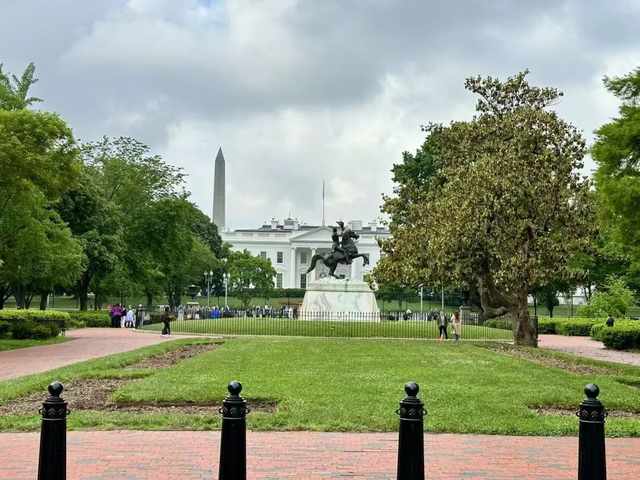

6月,在这次中国(China)之行之前,我曾向一小群香港(Hong Kong)市场分析师和投资者作过一次闭门介绍,谈的是华盛顿(Washington)对中国生物科技日益迅速变化的政策路径——从BIOSECURE和对外投资,到当时刚提出的众议院版本BINSA。讨论是在闭门环境下进行的,我也从未公开发表,但有一个问题始终萦绕在我心头:
美国能否在保护正当的国家安全利益的同时,不把自己与全球治疗创新隔绝开来、不拖慢患者获得治疗的速度,也不把价值创造推向别处?
两个月后,这个问题看起来更加重要了。
6月我发言时,BINSA还只是由约翰·穆伦纳尔(John Moolenaar)和黛比·丁格尔(Debbie Dingell)众议员提出的两党共同支持的众议院提案。8月6日,埃莉莎·斯洛特金(Elissa Slotkin)和皮特·里克茨(Pete Ricketts)参议员提出了参议院配套法案。因此,BINSA现在已成为一项两党、两院共同支持的提案。两院的提案都明确考虑审查涉及被涵盖的中国主体的药品许可、合资企业和股权投资。
这并不意味着BINSA会按现有文本通过,甚至也不意味着它一定会单独通过。但政治走向很重要。生物科技已经进入美国的战略竞争框架。争论的焦点越来越不是华盛顿是否在意,而是它会走多远。
TONACEA
等等——许可也是投资?
这正是生物科技无法整齐地套入那些最初围绕传统对外资本而设计的框架的地方。美国风险投资(VC)投向一家中国公司,容易理解。但如今许多生物科技交易流向相反:一家中国公司开发出分子,美国制药公司取得其许可。
资金流向中国,但资产来到美国。美国被许可方还可能贡献临床开发专长、监管专业知识、生产能力、验证能力,以及进入世界上最有价值的制药市场的渠道。这样的交易究竟是收购、投资、技术转让,还是仅仅购买一个产品?
在生物科技领域,许可转移的远不只是候选药品的知识产权(IP)。因此,交易结构日益重要。纯粹的地域许可不同于共同开发;将源自中国的资产投入一家由中国股权参与的美国新设公司(NewCo),又是另一种结构;直接股权投资则仍然不同。谁持有股份、谁控制董事会、谁获得技术诀窍、谁参与联合指导委员会(JSC)的决策、谁能够获取临床数据、谁保留经济利益,越来越成为地缘政治分析的一部分。如今,我会逐条谈判这些问题;我也分别站在被许可方和许可方的立场起草过相关条款。
而且,政策压力的范围比BINSA更广。BIOSECURE、对外投资、基因组数据规则、美国外国投资委员会(CFIUS)、美国国防部(DoD)清单、美国食品药品监督管理局(FDA)政策以及专利提案,正日益汇聚到把生物科技视为战略行业这一点上。
大棒来了。
然而,美国制度也包含了对挥舞这些大棒之人的制衡。6月,美国国防部(DoD)将药明康德(WuXi AppTec)列入§1260H清单后,药明康德提起诉讼。8月7日,一名联邦法官签发初步禁令,在案件审理期间禁止DoD执行该列名决定;法官认为,药明康德已经证明其依据《行政程序法》(Administrative Procedure Act,APA)提出的挑战很可能胜诉。
这同样是美国对抗美国(America Against America)。国会立法,行政机构采取行动,公司提起诉讼,法院进行审查。这个过程看起来很混乱,但这种混乱也可能是一种保障。
TONACEA
但最大的威胁可能就在家门口
在讨论如何维护美国的生物科技领导地位时,还有另一个问题值得更多关注。
如果美国成功保护了自己的生物科技创新生态系统,使其免受来自中国的影响,却又通过自身的药品定价政策削弱了这一生态系统的经济基础,会发生什么?
《通胀削减法》(Inflation Reduction Act,IRA)已经通过联邦医疗保险(Medicare)的价格谈判,改变了成熟药品的经济逻辑。该法一个颇具争议的特点,通常被称为“药片惩罚”(“pill penalty”),是小分子药物和生物制剂适用不同时间表。在现行法定框架下,小分子药物在获批至少七年后即可成为价格谈判对象,而生物制剂则是十一年;由于谈判价格会在更晚时候生效,行业通常将其描述为获批后约九年与十三年的谈判保护期。
这种差异是否确实会抑制小分子创新,以及抑制程度有多大,未来数年都将持续争论。但药品开发者和资本配置者不会等到计量经济学研究完成后才改变行为。预期未来现金流一旦变化,投资组合决策就会变化。
然后还有最惠国定价(most-favored-nation,MFN)。
MFN已不再只是一个假设。美国政府在2025年启动了这一框架,并于2026年5月表示,在寻求更广泛采用并最终将其纳入成文法的同时,已经与17家主要药品生产商达成自愿性的MFN安排。对于新药,该框架所宣示的目标是使美国价格与其他高收入国家的价格相当;美国政府明确表示,国际价格联动应当降低美国价格,同时对其他地区的价格施加上行压力。
目前,美国卫生与公众服务部(HHS)的基准是参考经济合作与发展组织(OECD)成员国中最低的药价,前提是该国人均国内生产总值(GDP)至少达到美国人均GDP的60%。因此,中国目前不在该MFN参考范围内。但这一方向对全球药品开发的影响极其重大。
传统上,药品定价具有很强的地域性。MFN正在削弱这种地域性。
如果一个国家的价格能够影响另一个国家的经济效益,全球被许可方就会更加关注药品在全球何时、何地以及以什么价格上市。一个大幅折价的海外上市不再只是当地子公司的问题;它可能变成一个全球定价问题。
这给中国许可交易带来了一个有意思的张力。
中国资产所有者通常强烈偏好保留中国区权利。理由充分:国内专业能力、对该资产的情感联系、未来上行空间,有时还有政策考量。但全球被许可方越来越希望控制——或者至少通过有实质意义的合同保护来影响——许可方保留地区的定价、折扣和上市顺序。
目前,中国本身不在已公布的MFN篮子中,因此我不会夸大当前的法律风险。但老练的交易人士总会思考今天的清单之外。MFN规则可能演变;其他国家也在采用各自形式的国际参考定价;而全球公司可能只是希望拥有管理全球上市和定价策略的灵活性。
我已经看到这个概念性问题逐渐进入交易讨论:定价磋商权、价格下限或护栏、上市协调、报销策略、信息权,以及其他旨在协调保留的地域权利与全球定价控制的机制。十年前,这类条款往往只是事后补上的内容;如今,它们已成为协议中谈判最激烈的部分之一。具体解决方案会因交易而大相径庭。
但更广泛的要点很简单:药品定价政策可以像国家安全政策一样改变交易结构。
TONACEA
全球权利的价值可能上升
这进一步印证了我出于地缘政治原因已经作出的一个预测。
去年,我把主导模式称为“中国制造,全球变现”(“Made in China, Monetized Globally”)。中国生物科技全球化1.0(China Biotech Globalization 1.0)是一种分割地域的许可模式:中国开发者保留中国区权利,西方合作方获得中国以外地区的权利,双方通过里程碑付款、特许权使用费和治理安排保持经济联系。
全球化2.0可能会有所不同。
国家安全监管提供了偏好更清晰分隔的一个理由。全球定价则提供了另一个理由。如果全球被许可方希望控制各市场的开发、上市顺序和定价,而持续的跨境治理本身又带来监管摩擦,全球权利交易的吸引力就会相应增加。
这并不意味着每笔交易都会变成全球收购。中国卖方通常会抗拒放弃本土市场,而全球权利的价格也更高。中国的监管、税务和商业考量仍然十分重要。但统一的全球控制之价值正在上升,而其原因与传统许可法理几乎没有关系。
TONACEA
大棒会向两个方向挥舞
这次中国之行也提醒我,拥有大棒的政府并不只有华盛顿。美国担心美国资本、技术诀窍和市场准入会强化中国的生物科技生态系统。北京(Beijing)则有自己的理由担心中国技术、资本和企业价值迁移到境外。
这对NewCo结构尤其重要。一家中国生物科技公司贡献一项资产或平台;全球投资者投入现金;海外管理团队搭建公司;中国发起方保留有意义的股权。从概念上说,这几乎是一个完美的全球化模式,因为中国创新者参与的是企业价值创造,而不只是收取特许权使用费。
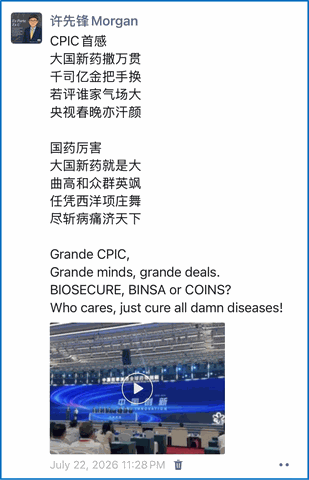
不过,从结构上看,这可能造成更多摩擦。当中国资产和企业价值转移至离岸架构时,中国的境外直接投资(ODI)制度、外汇规则、中国证监会(CSRC)境外上市框架以及相关考量都可能发挥作用。CPIC周围的一条暗线正是:科学与创业抱负正推动更深入的全球化公司建设,而监管基础设施却变得更加重要。
摩擦并不等于禁止。但摩擦会改变行为。
这就形成了一个有意思的对称关系。华盛顿会问:多少美国资本、技术和专有技术应当用于建设中国的生物科技生态系统?
北京则可以问:多少中国开发的技术和经济价值应当迁移到境外?同一个分子。同一笔交易。两个政府。两套焦虑。
TONACEA
生物科技不是半导体
但这一切仍然留下了核心政策难题。
分子不是芯片。专利会公开。临床试验会产生受监管的证据。FDA负责美国市场的上市审批。而且,与大多数战略性技术不同,最终使用者往往是需要治疗的患者。
假设一家中国公司发现了一种明显更好的癌症药物。美国人是否应当获得它?再假设美国禁止该项许可,但一家欧洲制药公司收购同一资产、开发该资产,最终又将其销往美国。中国仍然获得经济利益;美国患者仍然使用这款药;但全球开发和商业化价值却由欧洲公司攫取。
我们究竟是保护了美国生物科技,还是在补贴欧洲制药业?
地缘政治限制也与药品定价管制产生了尴尬的交集。政策制定者一方面希望美国保有全球领先的生物制药创新引擎,另一方面又希望美国人不再承担全球行业经济利益中不成比例的份额。两个目标都可以理解。但要同时实现二者要困难得多。
TONACEA
旅程终点与五个判断
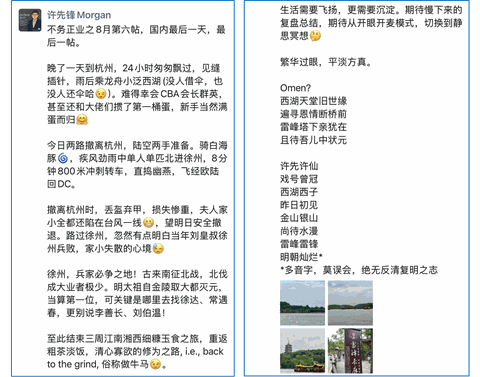
抵达上海(Shanghai)三周后,我在台风中离开杭州(Hangzhou),沿高速铁路经由徐州(Xuzhou)向北前往北京(Beijing),最终飞回华盛顿。
在那段旅程中的某个时刻,今年这篇文章的主题发生了变化。我原以为自己要再写一篇关于中国生物科技的文章。相反,回到家后,我想写的是美国。
那么,所有道路最终通向哪里?我在6月作出了五个预测。
第一,与CPIC上某位乐观的大投资人的预测相反,美国对涉华生物科技交易的审查范围出现实质性扩大,可能性很高。当然,最终的BINSA架构可能比今天的法案更窄,或者更为细致。
第二,中国向美国的许可交易将继续,因为其中的经济利益过于强大。话虽如此,交易可能需要更长时间,监管/地缘政治结构设计也会在流程中更早启动。这一点在实践中已经显现:监管审查的时间安排以及顺利通过审查的可能性,已成为大多数交易在条款清单阶段或更早时候,与其他关键尽职调查和结构设计问题并列的首要问题。
第三,受地缘政治分离以及统一全球定价控制日益重要的双重推动,全球权利转让可能变得相对更具吸引力。
第四,随着资本和许可需求寻求替代方案,日本(Japan)、韩国(Korea)及其他盟友的生物科技生态系统应会获得助力。要让这些地区抓住机会并获取更多价值,需要同时深入理解美国和中国。
第五,中国将越来越多地运用现有工具——ODI、上市规则、出口管制、外汇、数据监管以及可能采取的其他措施——来维护国内的影响力和价值。与美国不同,中国可以在这些领域中的任何一个即时收紧或放松力度。
在这五点之上,我现在还要加上第六个不确定性:美国制药市场本身的经济逻辑将会怎样?
美国庞大的药品利润池一直在为0→1发现引擎提供资金,吸引资本和人才,并使美国成为全球治疗领域不可或缺的市场。IRA价格谈判、MFN以及接下来出台的其他政策,可能改善可负担性——这是重要的公共政策目标,作为纳税人我也完全支持——但它们也会改变创新的预期回报。这种权衡的真实幅度仍然未知。本届美国政府自己就将MFN描述为一种尝试:把部分创新负担从美国患者转移给其他富裕国家。
这或许会奏效。也可能其他国家会拒绝支付更多。企业可能推迟上市、重构投资组合、改变许可经济条件,或要求对全球定价拥有更大控制权。很可能是这些情况的某种组合。
这让我再次回到美国对抗美国。
中国的崛起值得认真关注。华盛顿有理由就工业产能、数据、供应链和国家安全提出尖锐问题。但中国要为中国的选择负责。
美国要为美国的选择负责。
我们能否让美国的药品开发更快、更便宜?能否在维持0→1引擎的同时,维持/重建1→10?能否继续吸引全球最优秀的科学家?能否让药品更可负担,又不会无意中让下一代药品变得更难获得投资?能否在保护国家安全的同时,不把自己与全球治疗创新隔绝开来?
我仍然没有明确的答案。
但我越来越确信,这些才是正确的问题 – 同时也是很多生物技术掌舵人的共识。
生物科技的未来,不会仅仅取决于美国能否约束中国。
它将取决于美国能否改善美国自身。
美国对抗美国。

(上下滑动查看更多)
China Biotech 2026: America Against America
Authored by Morgan Xu, PhD, JD (LinkedIn) dictated, ChatGPT transcribed;
Part III — Here Come the Clubs
In June, before this China trip, I presented to a small group of Hong Kong market analysts and investors about Washington’s rapidly evolving approach to China biotech—from BIOSECURE and outbound investment to the then-new House version of BINSA. The discussion was behind closed doors and I never published the slides, but one question stayed with me:
Can America protect legitimate national-security interests without cutting itself off from global therapeutic innovation, slowing patient access and pushing value creation somewhere else?
Two months later that question looks even more important.
When I spoke in June, BINSA was only a bipartisan House proposal from Reps. John Moolenaar and Debbie Dingell. On August 6, Senators Elissa Slotkin and Pete Ricketts introduced a Senate companion. BINSA is therefore now a bipartisan, bicameral proposal. Both chambers’ proposals expressly contemplate scrutiny of pharmaceutical licensing, joint ventures and equity investments involving covered Chinese persons.
That does not mean BINSA will pass as written, or even necessarily pass on its own. But the political trajectory matters. Biotechnology has entered America’s strategic-competition framework. The debate increasingly is not whether Washington cares, but how far it will go.
Wait—licensing is investment?
This is where biotech does not fit neatly into frameworks originally conceived around conventional outbound capital. American VC investing into a Chinese company is easy to understand. But much of today’s biotech flow runs in the other direction: a Chinese company develops the molecule, and an American pharma company licenses it.
Money goes to China, but the asset comes to America. The American licensee may also contribute clinical-development expertise, regulatory know-how, manufacturing capability, validation and access to the world’s most valuable pharmaceutical market. Is that acquisition, investment, technology transfer or simply buying a product?
In biotech, a license can move much more than just the subject drug candidate IP. That is why structure increasingly matters. A pure territorial license is different from co-development; a China-origin asset contributed into a U.S. NewCo with Chinese equity is different again; direct equity investment is different still. Who owns shares, controls the board, receives know-how, makes JSC decisions, accesses clinical data and retains economic interests increasingly becomes part of the geopolitical analysis. These days, I negotiate these issues line by line, having drafted them from both the licensee’s and the licensor’s chair.
And the policy pressure is broader than BINSA. BIOSECURE, outbound investment, genomic-data rules, CFIUS, DoD lists, FDA policy and patent proposals are increasingly converging around biotechnology as a strategic sector.
Here come the clubs.
Yet the American system also contains checks on the people swinging them. After DoD placed WuXi AppTec on the §1260H list in June, WuXi sued. On August 7, a federal judge granted a preliminary injunction barring DoD from giving effect to the designation while the case proceeds, finding that WuXi had shown a likelihood of success on its APA challenge.
That is America Against America too. Congress legislates. Agencies act. Companies sue. Courts review. The process looks messy, but messiness can be a safeguard.
But the biggest threat may be closer to home
There is another issue that deserves much more attention in the discussion about preserving America’s biotech leadership.
What happens if America successfully protects its biotech innovation ecosystem from China—and then undermines its economics through its own drug-pricing policy?
The Inflation Reduction Act (IRA) has already changed the economics around mature medicines through Medicare price negotiation. One controversial feature, often called the “pill penalty,” is the different timeline for small molecules and biologics. Under the current statutory framework, small-molecule drugs can become negotiation-eligible after at least seven years following approval, versus eleven years for biologics; because negotiated prices take effect later, industry often describes this as roughly nine versus thirteen years of post-approval protection from negotiation.
Whether that difference actually suppresses small-molecule innovation, and by how much, will be debated for years. But drug developers and capital allocators do not wait for econometric studies before changing behavior. If expected future cash flows change, portfolio decisions change.
Then there is MFN pricing.
MFN is no longer purely hypothetical. The Administration launched its framework in 2025 and said in May 2026 that it had reached voluntary MFN arrangements with 17 major manufacturers while seeking broader adoption and eventual codification. For new drugs, the stated framework seeks U.S. prices comparable to those in other high-income countries; the Administration explicitly says international linkage should lower U.S. prices while putting upward pressure on prices elsewhere.
The current HHS benchmark looks to the lowest price in an OECD country whose GDP per capita is at least 60% of U.S. GDP per capita. China therefore is not presently part of that MFN reference set. But the direction matters enormously for global drug development.
Pharmaceutical pricing has traditionally been highly territorial. MFN makes it less so.
If one country’s price can influence another country’s economics, a global licensee suddenly cares much more about when, where and at what price the drug launches around the world. A deeply discounted foreign launch is no longer merely the local affiliate’s problem; it can potentially become a global pricing problem.
That creates an interesting tension in China licensing.
Chinese asset owners often strongly prefer to retain China rights. There are good reasons: domestic expertise, emotional attachment to the asset, future upside and sometimes policy considerations. But a global licensee increasingly wants control—or at least meaningful contractual protections—over pricing, discounting and launch sequencing in territories retained by the licensor.
Today China itself is outside the announced MFN basket, so I would not overstate the present legal exposure. But sophisticated dealmakers always think beyond today’s list. MFN rules can evolve; other countries use their own forms of international reference pricing; and a global company may simply want flexibility to manage worldwide launch and pricing strategy.
I am already seeing the conceptual problem work its way into transaction discussions: pricing consultation rights, floors or guardrails, launch coordination, reimbursement strategy, information rights, and other mechanisms designed to reconcile retained territorial rights with global pricing control. A decade ago, provisions of this kind would often have been an afterthought; now they are among the most heavily negotiated pages in the agreement. The exact solutions of course vary enormously by deal.
But the broader point is simple: drug-pricing policy can change deal structure just as national-security policy can.
Global rights may become more valuable
This reinforces a prediction I was already making for geopolitical reasons.
Last year I called the dominant model “Made in China, Monetized Globally.” China Biotech Globalization 1.0 was a split-territory license: China developer retains China, Western partner receives ex-China rights, and the parties remain economically connected through milestones, royalties and governance.
Globalization 2.0 may look different.
National-security regulation creates one reason to prefer cleaner separation. Global pricing creates another. If the global licensee wants control over development, launch sequencing and pricing across markets, and if continuing cross-border governance itself creates regulatory friction, worldwide-rights transactions may become incrementally more attractive.
That does not mean every deal becomes a global acquisition. Chinese sellers will often resist giving up their home market, and worldwide rights cost more. China regulatory, tax and commercial considerations remain significant. But the value of unified global control is increasing for reasons that have very little to do with traditional licensing doctrine.
The clubs point both ways
My China trip also reminded me that Washington is not the only government with clubs. America worries about U.S. capital, know-how and market access strengthening China’s biotech ecosystem. Beijing has its own reasons to worry about Chinese technology, capital and corporate value migrating offshore.
That is particularly relevant to NewCo structures. A Chinese biotech contributes an asset or platform; global investors contribute cash; an overseas management team builds the company; the Chinese originator retains meaningful equity. Conceptually, this is almost a perfect globalization model because the Chinese innovator participates in enterprise-value creation rather than merely collecting royalties.
Structurally, however, it can create more friction. China’s ODI regime, foreign-exchange rules, CSRC overseas-listing framework and related considerations can matter when Chinese assets and corporate value move into offshore structures. This was one of the undercurrents around CPIC: science and entrepreneurial ambition are pushing toward deeper global company-building just as the regulatory plumbing becomes more consequential.
Friction is not prohibition. But friction changes behavior.
This produces an interesting symmetry. Washington asks how much American capital, technology and know-how should help build China’s biotech ecosystem. Beijing can ask how much Chinese-developed technology and economic value should migrate offshore.
Same molecule. Same transaction. Two governments. Two sets of anxieties.
Biotech is not a semiconductor
All of this still leaves the central policy problem.
A molecule is not a chip. Patents publish. Clinical trials generate regulated evidence. FDA controls U.S. market approval. And, unlike most strategic technologies, the end user is often a sick patient.
Suppose a Chinese company discovers a materially better cancer medicine. Should Americans get it? Suppose America prohibits the license but a European pharma acquires the same asset, develops it and eventually sells it into the United States. China still receives economics; American patients still use the drug; but the European company captures the global development and commercialization value.
Did we protect American biotech—or subsidize European pharma?
Geopolitical restrictions also interact awkwardly with drug-pricing controls. Policymakers simultaneously want America to retain its world-leading biopharmaceutical innovation engine and want Americans to stop paying a disproportionate share of the global industry’s economics. Both goals are understandable. Achieving both simultaneously is much harder.
Journey ends and five bets
Three weeks after arriving in Shanghai, I left Hangzhou in the middle of a typhoon, rode the high-speed rail north through Xuzhou to Beijing, and eventually flew back to Washington.
Somewhere along that journey, the subject of this year's essay changed. I thought I was going to write another piece about China biotech. Instead, I came home wanting to write about America.
So where do all the roads end? I made five bets in June.
First, unlike an optimistic lead investor’s prediction at CPIC, some meaningful expansion of U.S. scrutiny over China-related biotech transactions is very likely. Of course, the final BINSA architecture may be narrower or more nuanced than today’s bills.
Second, China-to-U.S. licensing will continue because the economics are too powerful. With that said, transactions will likely take longer and regulatory/geopolitical structuring will move earlier in the process. That is already visible in practice: timeline and likelihood of getting through regulatory review is a front and center question among other key diligence and structuring questions at or before most deals’ term-sheet stage.
Third, worldwide-rights transfers may become relatively more attractive, driven by both geopolitical separation and the growing importance of unified global pricing control.
Fourth, Japan, Korea and other allied biotech ecosystems should receive a tailwind as capital and licensing demand seek alternatives. How those areas seize the opportunity and capture more value requires a deep understanding of both U.S. and China.
Fifth, China will increasingly use its own existing tools—ODI, listing rules, export control, foreign exchange, data regulation and potentially other measures—to preserve domestic leverage and value. Unlike the U.S., China can turn up or down the heat in any of these areas instantly.
I would now also add a sixth uncertainty above all five: what happens to the economics of the U.S. pharmaceutical market itself?
America’s enormous pharmaceutical profit pool has helped finance the 0→1 discovery engine, attract capital and talent, and make the United States the indispensable market for global therapeutics. IRA negotiation, MFN and whatever comes next may improve affordability—an important public-policy objective that I also support as a taxpayer—but they also change expected returns on innovation. The real magnitude of that tradeoff is still unknown. The current Administration itself describes MFN as an attempt to shift part of the innovation burden from American patients toward other wealthy countries.
That may work. Or other countries may resist paying more. Companies may delay launches, restructure portfolios, alter licensing economics or demand greater control over global pricing. Probably some combination.
Which returns me to America Against America.
China’s rise deserves serious attention. Washington is right to ask difficult questions about industrial capacity, data, supply chains and national security. But China is responsible for China’s choices.
America is responsible for America’s.
Can we make American drug development faster and cheaper? Can we preserve the 0→1 engine while sustaining/reinforcing 1→10? Can we continue attracting the world’s best scientists? Can we make medicines more affordable without unintentionally making the next generation of medicines less investable? Can we protect national security without cutting ourselves off from global therapeutic innovation?
I do not have clean answers.
But I am increasingly convinced these are the right questions – also a consensus among many biotech leaders.
The future of biotechnology will not be determined simply by whether America can constrain China.
It will be determined by whether America can improve America.
America against America.
相关阅读
